Showing posts with label skin. Show all posts

7.2.13

Body Horror - The Eternal Grind


These images accompany a paper presented at the 1st International Body Horror Conference in Sydney. 

If you fancy a read of my paper you can access the draft publication online here: The Eternal Grind: Living Bodies Reduced to Dust.


12.9.11

Representations: Ron Mueck and the frozen moment

I consider myself very fortunate to have caught the final days of the National Gallery of Victoria's exhibition of Ron Mueck just as The Great Relocation For Research drew me southward at the beginning of 2010.

Ron Mueck. Dead Dad (1997), detail. Pregnant Woman (2002).

Having come across Pregnant Woman many years ago in the National Gallery of Australia in Canberra, I immediately became a convert and was particularly struck by the weight of the piece -  this was a woman caught in a single moment of silent stillness. Weighed down by her heavily pregnant belly, her feet braced stolidly apart to support her changing form, she exudes a quiet weariness. Onlookers can observe the translucency of her skin, the blue veins and stretch marks and slight blush on her cheeks, the bead of moisture on her lips and fine lines around her eyes. The realism is uncanny. At over 2.5 metres tall she stands solitary and frozen, the enormous weight made visible as she focuses herself inward. 


This embodies the powerful formula behind Mueck's work - startling moments of personal intimacy and vulnerability are captured in time as the hyper-realism of the pieces is offset by their alarming detail.  Rendered in the miniature or at a gigantic scale the moment is both lain bare and concentrated as the narrative is contained by halted time.

Woman with Sticks (2008)


  Of the exhibition, the NGV writes on its site:

"Mueck’s sculptures are some of the most widely acclaimed, prominent and identifiable works in the international contemporary art arena. Often naked and suspended in states of self-consciousness, introspection or deep contemplation, his figures present both emotional and physical states of exposure.

As viewers we experience a level of unease that is borne of a voyeuristic awkwardness, as though we have invaded some kind of personal space. However, we also identify with the human condition these poignant moments express.

Astounding in their apparent realism and compelling in their ability to invite interaction Ron Mueck’s works have earned him a singular place as the creator of some of the most evocative sculptures of our time.

This is the most comprehensive exhibition of work by the Australian-born, London-based artist to have been presented in the southern hemisphere. It includes four new works by Mueck in addition to some of his major, recognised works including the iconic Dead Dad 1996/97."


Mask (1997)
Dead Dad (1997)


Dead Dad was commissioned along with two other sculptures (Angel and Mask) by influential art collector Charles Saatchi for the Young British Artists show Sensation in 1997. The piece is tiny, a mere 1.2m long. His skin is rendered wan and pasty in death, greying and spotted with light stubble as he lies limp and exposed on the floors of galleries across the world.

The vulnerability of the piece is heart wrenching and in stark contrast to Mask, which at almost 1.5m tall is confrontational, gigantic - and frankly terrifying - with its direct, belligerent gaze. Yet the experience of rounding the corner and discovering the featureless shell that is the back of this very solid looking face is by far the most unsettling aspect of the work. This piece, and the similarly monumental Mask II (2002) bring the illusion of the realist form and emotional narrative embedded in these skin surfaces tumbling down when seen from a revelatory angle.            


Wild Man (2005)

The experience of touching the provided material samples in the NGV exhibition is also a revelatory experience. Revealing what the respectful distance of a gallery environment does not, the tactility of the sculptures is exposed as cold, hard, and very solid. Made from resins, silicone, polyurethane, fibreglass, aluminium and steel armatures, and synthetic hair fibres these pieces are a tribute to the power of representation and illusion.

In pieces like Woman with Sticks, Wild Man, Spooning Couple and Two Women the skins of the subjects are inscribed with their immediate experiences. The Woman with Sticks has roughened hands from her ongoing hard labour and pinkening scratches from the branches she struggles to carry criss cross her arms. Wild Man (my favourite Mueck piece) has pimples on his back, oversized pores on his nose, sunspots, overgrown hair, callouses on his toes, fragments of dirt under his nails, and has raised veins as he grips his oversized chair in terror. Already a contextually powerful piece (the crowds of gallery going onlookers clustered in intense scrutiny could be the source of his discomfort), these markings signify his life that has taken place away from culturally established standards of personal presentation.   

Spooning Couple consists of a small scale man and woman in the midst of sleep, skins subtly charged with the differences of gender - hers pillowy, soft, dappled, and loosened at the stomach (has she had a child?), his tauter with the implied underlying structure of a male physique with less fat. The Two Women are wizened, softly paunched, delicately wrinkled, and expression lined with the years preceding their current age.

These are examples of the highly emotive, richly detailed works that Mueck has perfected. His sculptures have been elevated to a level of hyper-reality that leaves observers with an uncanny sense of connection and wonder at the minute detail captured at these different scales. Particularly, the nuanced role that skin has in communicating our histories and present experiences.


Two Women (2005)


Spooning Couple (2005)


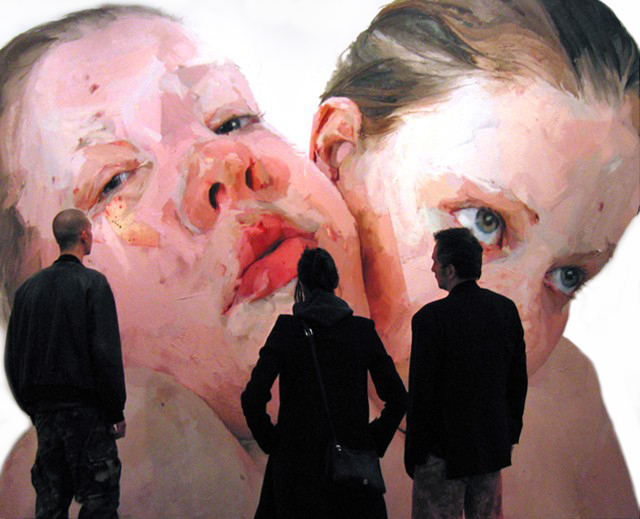
Representations: Jenny Saville the fleshy female


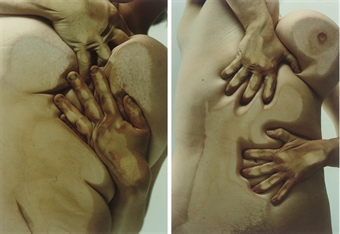
Jenny Saville & Glen Luchford. Closed Contact. (2003). C-print mounted in plexiglass. 
Once on a roll inertia takes care of the rest... there are so many great practitioners with skin-related offerings that I just can't wait to present here!

Jenny Saville is one such artist.  Skin in these works is expansive and sensual; imprinted with a visceral vitality as it envelopes the folds and fleshy forms of female body, it is caught in moments of vulnerability, ponderousness, and in pain after brutal interventions. The sheer size of these canvasses is astounding, viewers are overwhelmed by walls of skin in all its confronting glory.


An English painter and one of those Young British Artists, Saville's entire senior show was notably purchased by leading British art collector Charles Saatchi, who then commissioned works for the next two years. Impressive, no? Best known for her monumental women, usually self portraits, Saville spent substantial time observing plastic surgery operations in New York and draws on these experiences as subject matter for her traditional figurative oil paintings. 

Surgeries, liposuction, trauma victims, deformity correction, disease states and transgender patients feature heavily in images that are highly emotive and strongly pigmented. In the Closed Contact series, Saville collaborated with fashion photographer Glenn Luchford to capture the full range of color, tonality, and topography of live flesh through her own body. Flesh is manipulated and animated by gripping hands as the contorted body is pressed against glass sheets. Exploring the violence and anesthetized pain of observed surgeries, Saville's distorted bodies range from the grotesque to great, ponderous beauty.

Jenny Saville & Glen Luchford. From the Closed Contact series


On a secondary note, I find it particularly interesting that Saville's subjects roughly fall into two categories: bodies are either curiously disembodied and exposed to the intense scrutiny of observers, or the subjects gaze past the viewer, inviting entry into that moment of experience. Whether these vacant stares are out of  numbness or obliviousness is ambiguous, but it would be interesting to spend a bit of time on a feminist analysis of her work, especially in comparison to other forms of female carnal art (Orlan being the main culprit).

Representations: Skin detail sketches


Body Map 7, Body Map 4, Body Map ? , Body Map 1, (2009). Skin detail drawings from rileypile


I'm particularly interested in representations of skin. Images or creative interpretations of a subject say far more about cultural attitudes, trends, and the artist than the depiction often does.

Featured here is the student work of rileypile which I find particularly engaging for its diversity and fresh, raw intersections of materiality, object and line. Yes. Fresh and raw, and sort of meaty...


Stitches Thumb. (2009). oil on board.


Geoff: scab day 5. (2009). Pencil and carving on wood block.


Tattoo scab. (2009). Oil and acrylic on board and foam core.

Geoff: scab day 3. (2009). Mixed Media.


8.9.11

Brief Reflections on Attachment: 'between' and the skin wearable

Firstly some background... Over the past year much of my work has involved treating the skin as a wearable by creating temporal custom jewellery and seeing what possibilities come out of subverting accepted practices of adornment.

This has been a process of (un)learning by abandoning assumed sites of adornment (outcome: jewellery for the inner nostril), addressing preciousness (outcome: gold leaf shaped by the lived experience of the wearer's body and movements), and challenging cultural assumptions surrounding beauty practices (outcome: tan lines from a lurid artificial tan in the form of enormous, lacy sebaceous glands).

Working with the skin as wearable has required an ethical, theoretical and practical awareness of the organ's porosity. Initial experimentation with temporal wearables has developed into a practice that places emphasis on collaborations, the philosophy of perception, social signification, and the properties of individual bodyscapes. The physical 'attachment' of skin and wearable is by necessity brief, and the skin left ultimately untouched at the end of the wearable life. The focus becomes memory, codification, and the constitution of experience.
Tarryn Handcock. Tanlines (day 1). Artificial tan, sebaceous gland lace, carbon transfer. 2010. Photo: Matthew Burgess


Now to the present... 


Both teaching and a recent return to creating tangible objects has led me to survey the realm of the wearable with new eyes. A latent fascination with methods of joining has resurfaced, along with a growing awareness of what it means to attach artefacts to our person in a particular way, and for a particular period.

The (current) title of my thesis  is ‘Nostalgic Skin’: dissipating boundaries, between body and wearable. More discussion at a later date, but the term most pertinent to this reflection is 'between'. That's a cracker of a word isn't it? Slippery, oscillating, amorphous, adrift. In joining and attaching objects/materials to the body 'between' becomes a murky trope. States form 'between' skin and wearable spatially, physically, psychologically, and symbolically.
 Cinnamon Lee. Covert Jewels. 2011.

The matter at hand... Established in jewellery theory is the duality of the worn object as both a signifier for an audience and an artefact imbued with personal value. Established too, in this is the dichotomy between the intimate interior of the ring and its outer, public face. Reveal/conceal, as beautifully illustrated by Cinnamon Lee's recent work, Covert Jewels shown at Metalab, is often about the private experience hidden from the world at large, between the object and wearer.

For wearables in direct contact with the skin - garments, prosthetics and medical aids, jewellery-objects like necklaces, earrings, bracelets, rings - this is a relatively direct relationship of skin to non-skin material. The methods of 'attachment' to the body include, but are by no means limited to, encirclement, piercing, suction, wrapping, and tension. Between skin and wearable there is a perceptual relationship formed around sensory input from the object's materiality, method of wear, site, biofeedback, memory, and imaginative possibilities inspired by the experience of the artefact with the lived body over a period of time. This relationship is based on the assumption that these artefacts are removable, but that enduring relationships can result in an incorporation into body schema and self-identity. There may be a clear distinction between the intimate, personal zones of the artefact (the socket of a prosthetic, interior of a ring, hook of an earring, inner seam of a dress) and the zones that are public. These are most often established in accordance with the concealed/revealed zones of skin, the private areas forming out of the experience generated 'between' skin and wearable.


(left) Kathleen JacksonSkin: Necklace. Prosthetic gelatine jewellery attached to the wearer using prosthetic adhesive, prosthetic gelatine blender, and rubber mask grease paints


(right) Tiffany Parbs. Rash. 2004. Skin and rash from allergic reaction.


A question...

What does it mean for the skin to be implied in the 'wearable'? I have stood by the interpretation that the 'wearable' is an entity that implies the body and may be worn or borne by it. Yet what it means to 'attach' this to the skin of the body has become something of a contentious issue.  

The garment, jewellery-object, cosmetics, prosthetics, and medical aids are all worn in direct contact with the skin and have distinct socially encoded and functional properties. Body modification practices including implants, artifical organs, bone replacements and tattoos are assimilated into the body on a permanent basis, the skin barrier willfully torn asunder. And nano-technology, oils, energy waves, dusts, bacteria, parasites and viruses all traverse the porous skin membrane to be carried with the body and be manifested in various ways. Not only are the methods of attachment at issue, but the very ascertainment of boundary and what might not be worn, borne or attached to the body by some means or another is at stake.
The contemporary wearable could be attached through means previously unacknowledged - absorbed and embedded in our being, or ingrained in our surface. It could be slowly dissipating like dust motes in sunlight, suspended on our outer layers of garments, absorbed as an oil, projected from the body, or shed like fleeting clouds of dandelion spores in our wake.


more thoughts to come...