|
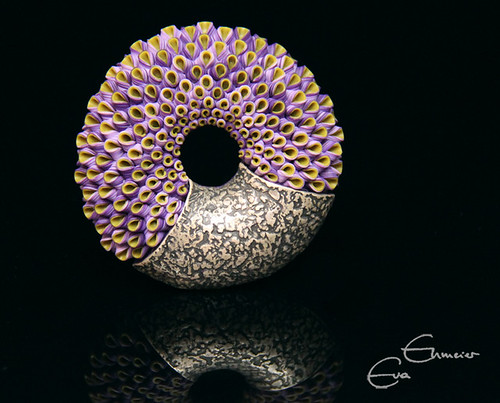
| Hoedlgut. Carved Rings, polymer with texture panels. | | | |
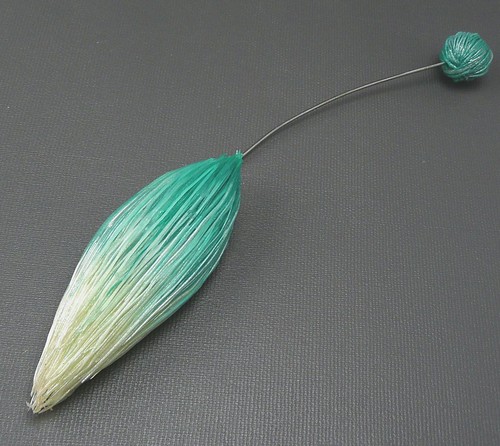
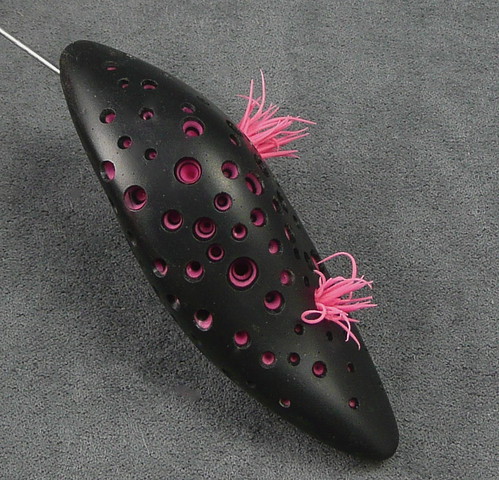
(top row) Malodora. Colour challenge pins. Polymer, and polymer with koosh tentacles.
The humble polymer clay is one of the best materials for model making and creating delicate pieces for casting due to highly durability, detail retention, variable plasticity, and post-cure finishing properties. Yet it is persistently frowned upon as a suitable material for use in jewellery pieces, perhaps as a result of 'craft' overtones, an association that dubiously leads to it being deemed what may be termed 'not precious enough'.
... But, seriously people? Let me tell y'all a little something 'bout preciousness and contemporary jewellery, via the venerable Susan Cohn who is arguably amongst Australia's most influential contemporary jewellers today. Read on for insight ...
A little history:
The Contemporary Jewellery Movement (CJM) grew out of Modernism, and developed as "intellectual alignment
among jewellers took place through a shared questioning of jewellery’s social
role, mixed with experimentation with new materials. The cultural resistances
of the early movement were configured towards an agenda that emphasised the
democratic nature of jewellery and renewed its connection to the body.”
From here the movement adopted three key principles:
"First, the value of precious materials in jewellery was seriously
challenged, and jewellery was deflated as a status symbol. The use of
non-precious materials would become a benchmark of contemporary jewellery.
Second, there was a newly apparent need for jewellery to maintain its
relationship with the body, and jewellery was made with the intention that it
be worn. Third, contemporary jewellery was made to be accessible for everyone,
regardless of age, gender and class.”
 |
|
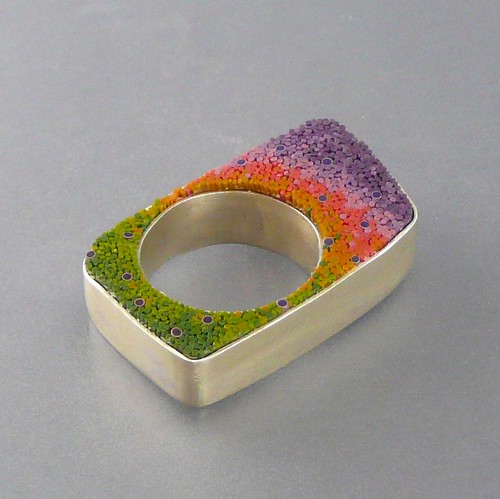
Fabricated sterling silver, polymer micromosaic. |
Accessible and using non-precious materials, eh? Yet certain developments occured...
"There is ready acceptance among contemporary
jewellery’s niche clientele (which includes its makers, audiences, owners and
wearers) that work will be non-precious, experimental and ‘democratic’.
However, the radical social overtones of these parameters have largely been
absorbed. Jewellers appear unable to reinvigorate contemporary jewellery’s
concerns over the object’s values, roles and currency. New jewellers who seek
to renew the anti-elitism of contemporary practice must go further than merely
rejecting non-precious materials (which have now come into widespread
acceptance)."
“The most contentious debate, and root to all others, was on the
‘proper’ function of jewellery. Views diverged on matters of materials
(precious or non-precious), wearability (jewellery or sculpture), and value
(elite or democratic). These debates extended the manifesto of the movement and
polarised the CJM field. Makers sought to differentiate themselves on common
grounds of artistic content (biographical or political), inter-disciplinary
positioning (craft or art) and intended audience (gallery or shop)."
The lack of early critical introspection in the movement (especially in the limited local arts scene) may still be manifesting as a need to establish the function of the object itself, but the crux of this is rooted in the ongoing CJM identity crisis. Namely, the desire to distinguish itself from craft. The art/craft/design debate has persistently distracted contemporary jewellery from the potential of other
theory.
So how does craft become defined when confronted with a contemporary jewellery movement that still largely favours a handmade approach?
According to jeweller/critic Bruce Metcalf, craft makers fixate on the functionalities of the finished
objects they produce, craft makers, and "tend to envision ‘their production as a means of
distributing experience’. Such a stance (which underscores
the frequent rejection of theoretical engagement in craft) succeeds in
inhibiting the ongoing transformative impact and open interpretation of craft
objects in the everyday. It is clear, however, that once objects enter through
their display and use into the cultural stream of the everyday – and this is particularly
true of jewellery-objects – they attain the potential to alter the ground on which
they stand, to transform the networks in which they circulate, and to be syncretically
recoded in the process.”
And from the theorist/critics, Peter Dormer defines craft as a ‘practical philosophy’ or knowledge
process, and Sue Rowley states that "The ascribed conservatism
of craft is pivotal to maintaining the radical traditions of art,” by acting in contrast to the heavy emphasis of theory in fine arts discourse, thus establishing an arts-craft dichotomy.
It seems the contemporary manifestation of the CJM is not just about the issue of non-precious materials, but about determining the role of the object, and firmly establishing the theoretical standing of the movement in order to move beyond situational debate. Given that most contemporary Australian jewellers will at some stage be using a combination of hand making, outsourcing, utilizing commercial modes of production, and experimenting with a variety of materials, it's fair to say that the design/art/craft border will remain blurred. Get over the Us And Them already!
That's not the say that there has been no progress made in the direction of contemporary jewellery theory. The body of theoretical knowledge grows as gaps in the field become obvious. The dispersed field is rediscovering solidarity as record numbers of design outlets, galleries, and studios proliferate.* With it, the movement is rediscovering the need to position itself strongly amongst the other booming art/design sectors and to engage in critical debate about the future of design.
On the topic of jewellery function, Cohn herself writes that:
“For wearers, the value of
jewellery lies in the ways it ‘talks’: its unique capacity to attract, deflect,
evoke, provoke, guard, reveal, seduce – in other words to perform. For viewers, formed into anonymous audiences, jewellery provides
material for the games of daily life: the reading of peopled environments,
forging of alliances, stimulation of desires, and touching between object and
skin. The language of jewellery is never fixed because the relationships
between makers, wearers and audiences are ever changing."
This is the crux of the wearable: Evolving networks, performance and codification.
As part of this, materials become heavily invested with meaning. Perhaps the aversion to polymer clays is an uncertainty over what codes are actually conveyed. I think it can be said, given the examples by the two artists (artisans/designers/jewellers/craftspeople) featured in this entry, that in skilled hands polymer clay does posses the ability to give a nuanced 'performance' as jewellery.
Embedded in the practice of these artists, who also use metalsmithing and more traditional jewellery making methods, polymer clay is realised as a material with great versatility and possibility. It can be sculpted, carved, is highly compatible with other materials, can be finished in any number of ways, and yes, can reach a level of refinement that, in my opinion, makes it worthy of moving up in the esteem of contemporary designers beyond model making applications.
........
*For further reading of Susan Cohn's thesis, Recoding Jewellery: identity, body, survival, the full text
can be accessed here.
*For Bruce Metcalf's article on hand making and the question of craft, The Hand: at the Heart of Craft look here.
*Key local contemporary outlets/galleries/studios I recommend:
- Metalab
- Object Gallery
- Studio 20/17